Ziegensauger Doppelmaibock

Dpils24
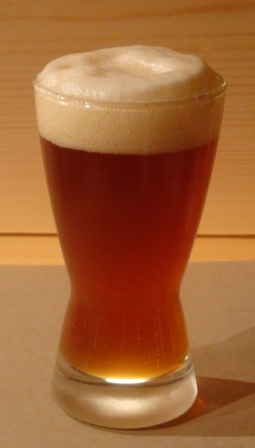
What would you get if you tripled every ingredient in a lager beer except the water? Zeigensauger Doppelmaibock: a recipe that has evolved from the German bock lager tradition, but inspired also by ‘t Ij Columbus beer, brewed in Amsterdam.

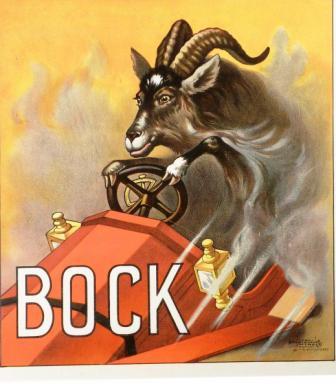
Ziegensauger, like Columbus, comes in at 9% ABV, making it considerably stronger than Maibock-style beer, which traditionally maxes out at around 7.5%. That makes this a Doppel Maibock! The traditional symbol of bock beer, the goat, has been consumed in this case by the German version of the Chupacabra. Zeigenrsauger is a goat hell-bent on destruction. bock goatw

Zeigensauger gets its fullness of flavor from a micro-mash of pale, pale crystal, Munich, CaraPils, and even black malt. The backbone is provided by 3.4 kilos of Cooper Pilsner extract, and 1.5 kilos of Breiss extra light DME. The beer is hopped with German Hallertau, Crystal, Pearle and Saaz varieties for the main additions, and dry-hopped with more Hallertau, which lays down a spicy aroma beside the rich maltiness.

Wyeast 2112 California Lager yeast, with its high alcohol tolerance, ferments the brew for four months at a temperature below 16 C (61 F.) It is bottled using corn sugar syrup made with a Saaz hop tea. Held another two to six months, this is a monumental beer that crashes around like a goat, sucker!

Big Chico Creek Water

BigChicow

Big Chico Creek runs ice cold out of the Colby Mountain watershed, over the basalt rocks of the Lassen volcanic shield, and through Bidwell Park and Cal State University in Chico, California. When the temperature hits 117 F in downtown Chico, the swimming holes of Big Chico Creek offer a welcome relief.

Big Chico Creek Water is another ice-cold treat for a hot summer day. I first brewed it for a Fourth of July party I went to in Chico. The hostess, my boss, had invited a few of her employees over for the party, but when we got there it became obvious that we were expected to be wait staff for the real guests, who were her neighbors! The most ambitious guy among us went over to the barn and mucked out the stalls. Big Chico Creek Water offered a welcome relief….

Big Chico Creek Water has no fixed recipe. A beer constructed of leftover amounts of specialty grains, it nonetheless retains certain characteristics. It is very malty, dark amber, with assertive hop bitterness and hop aroma, medium-full body and a bitter finish. Its 5.5 to 6% ABV makes it a bit more than a session beer, but still eminently quaffable. The key ingredient is the “Chico” California ale yeast, which produces a dry but malty beer with a nice full flavor accentuating the hops.

A typical recipe is about 75% pale malt. Anywhere from 400 to 700 grams of specialty malt for a 20 liter batch provide the amber maltiness. This version uses Cara Munich, crystal blend, Special B, Breiss Extra Special, chocolate, and black malts. Flaked barley contributes graininess and a full head.

As with the grain bill, the hop additions vary depending on what is at hand. I have used Nugget, Columbus, Ahtanham, Kent Golding, Challenger, Chinook, Cluster, Cascade, Styrian, Fuggle and Willamette in various combinations. This one is a melange of home-grown hops. A bit of gypsum and sea salt adds an edge to the hop ingredients.

This is a great beer if you want to be drinking a full, rich malt-hop extravaganza in less than four weeks. The yeast ferments quickly, drops out fast, and leaves a bottle-ready brew right in the primary fermenter. Two weeks in the bottle and the potion is dry and smooth, though it will develop its complex flavor for six months or more.

Umami Hack: Cooper Pils

Cooper HackAll-grain home brewing may be the ultimate umami experience when it comes to beer, but sometimes it’s just too hard to find the six to eight hours it takes to homebrew from scratch. Sometimes 20 minutes for a kit beer is all there is time for. The brewer who is able to put in an extra hour though, can change a mediocre canned kit into a very nice session beer.

The base for this beer is Thomas Coopers Selection Pilsener liquid extract, prehopped with Saaz hops. The Coopers Selection series are marketed as premium products, although they are typically priced the same as all the other Coopers extracts. Coopers recommends the kit be made with 500 grams of dry malt extract and 300 grams of corn sugar. The instructions for making a batch say that the ingredients should be merely stirred into six gallons of hot water, which I have found results in a weakly-flavored beer of perhaps 4% ABV.

The key to the hack is a mini-mash of Munich and Victory malts, flaked barley and sea salt. Munich malt is typically used in Bock-style beers, and contains enough enzymes to convert its starches to sugar. It’s a bit darker than pale malt; the type in this recipe is about 10 Lovibond in color and adds a smooth malty sweetness to the beer. Victory malt is a Breiss Malt specialty roast that adds a clean nutty, baked bread flavor. Both of these are used only in small amounts to add roundness and complexity to the flavor of the standard kit brew. The flaked barley adds mouthfeel and enhances head retention. Sea salt reacts with the umami-producing components of the malted grains to increase the roundness of flavor.

To hack the kit I extracted about a gallon of wort from my mini-mash, added two more gallons of filtered water, brought this to a boil and poured in a half-kilo of light dry malt extract. This was simmered for a half hour, with 20 grams of fresh Willamette hops added continuously during the boil: five grams every seven minutes.

The Cooper Pilsener extract was added with five minutes left to the boil. A half-kilo of corn sugar was added at the last minute. The wort was cooled and topped up to make 20 liters. Starting gravity was 12.5 Plato.

I have found that the Coopers premium Pilsener yeast supplied with the kit actually works pretty well, delivering a crisp dry taste when the brew is fermented and lagered at cellar temperature (about 60F or less.) I speculate that Coopers has worked on developing a strain that will produce good results without the average home brewer needing to invest in a special lager brewing set-up that will maintain colder temperatures.

This turned out to be a very nice golden lager that I was able to make, with the kit on sale, for about $20. With a firm white head and an aroma of malt and hop spiciness, it is full-bodied, with a good malty flavor finished with considerable hop bitterness. The ABV is about 5.3% making it a decent tipple. Its nonetheless moderate alcoholic strength makes it a beer that is fine for a couple of pints after a hard day hacking bits down on the cube farm.

Sparkling Dry English Cider

Sparkling English CiderSparkling hard cider may hold only 1% of the beer market, but sales grew 84% in 2012, eclipsing by far the 17% growth rate for craft beer. A well-made cider is certainly a thing of beauty, but even a middle-market commercial cider offers a welcome respite from high amplitude hop bombs.

In the UK and Ireland though, beer and cider taps exist as equals at the pub. Locally crafted brands of cider have been there for decades. The key to these brands’ drinkability is the care that goes into the blending of juices that create a full-spectrum flavor.

English ciders are known for the blend of varieties specifically grown for the purpose. These apples are virtually unobtainable outside the small areas in which they are grown. It’s possible to make a good beverage without them, however, with a little creativity.

The recipe for this cider starts with a base of Cortland, Red Delicious and Gold Delicious sweet apples. Gravenstein and McIntosh varieties provide aroma, and Jonagold offers tartness. Crab apples substitute for English cider apples in furnishing tannins, as well as additional acid. The apples were milled, and pressed to express blended juice, which was pitched with White Labs’ WLP775 English Cider yeast. A malolactic culture was added to the secondary fermenter to make the acid flavor more smooth. Oak chips contribute a mild, woody barrel taste and aroma.

While this doesn’t qualify as an English Farmhouse Cider–it was sweetened a bit with wine conditioner and carbonated with the Charmat process, it is an excellent brut with about 1% residual sugar, well-balanced acid and a full, rich vanilla flavor with very light oaky background notes. The aroma is quite apple-y, and an empty glass retains this for quite some time. It’s disappearing from the cellar very quickly.

Alt Radschläger

AltRad2 Der Radschläger is a Düsseldorfer tradition. In the most famous version of its origin, it refers to the legend of children performing cartwheels in the streets, celebrating the victory of John of Brabant over Henry VI, Count of Luxembourg, at Worringen, in one of the largest battles of the Middle Ages. Today the cartwheel is still celebrated across the city in sculpture, art and events, becoming a virtual symbol for Düsseldorf.

Altbier is also a Düsseldorfer tradition. This is a hoppy ale, brewed in the “alt” (old) manner, as it was before lager became the predominant style in German brewing. Over time the yeast used in Düsseldorf became acclimated to lower fermentation temperature, allowing Düsseldorf brewers to create a beer that was crisper, with less fruity flavor than the ales typical of warmer brewing regions. Altbier is brewed at cellar temperature, and then aged at a lager temperature, making it in the parlance of brewing style definition a “hybrid” beer.

Alt Radschläger is a partial-mash brew, based on pale malt, Munich malt, four kinds of crystal malt, Melanoidin malt for copper color, and a portion of wheat malt. These are prepared using a triple-decoction mash schedule, to develop a rich flavor. The grains themselves were delicious while cooking. English light dry malt extract was added to this wort, along with a few grams of French sea salt.

The hops were all home-grown, consisting of Nugget, Willamette, and feral Fuggle varieties from Nelson, BC. The brew was pitched with White Labs WLP036 Düsseldorf Alt yeast and cool fermented in the primary after racking off the trub. After ten days the beer was racked again and cooled to 3 Celsius, to lager for six weeks. It was then bulk-aged for six months at cellar temperature.

Alt Radschläger probably qualifies as a sticke alt or “secret” ale, a stronger version that is often brewed for seasonal or special occasions. Starting at 14 Plato and finishing at 1.5, with the bottling sugar it contains about 7.2% ABV–producing a noticeable desire to turn cartwheels, even among the elderly.

It is a copper-gold color with a thick, long lasting head. It has a malty aroma with just a hint of hops. The flavor shows very complex maltiness with a strong taste of caramel. Big roundness of flavor ends with a bitter finish. Alt Radschläger won a gold medal to advance to the national homebrewing championships in Seattle. One of the judges noted “If this beer was commercially available I’d buy it.” I would too!

Solstice Heather Mead

mead ins12Mead fermented with heather, the mead of the Picts and Celts, was actually made throughout Britain, and in Scandinavia as well. Often associated with the legendary “Mead of Inspiration“, wherever it has been made it was believed to have extraordinary effects.

Wild-harvested, unwashed heather blossoms are frequently infected with a kind of mildew, locally called “fogg,” that is related to ergot. Heather tips must be thoroughly washed to rid them of the fogg before they are sold or used in brewing. Unfortunately, this process removes as well a natural yeast that was used in olden times to ferment meads and ales made with heather. Nonetheless, heather blossoms themselves produce a mild narcotic and sedative effect, and appear as a traditional ingredient in herbal medicine. So it is possible to ferment a heather mead that is somewhat psychotropic, and delicious as well–a taste of ancient Pictish culture.

While the heather blossom’s contribution to the mead is unmistakable, the real key to its authenticity is heather honey. This honey is truly remarkable. In addition to its unique, distinct taste, heather honey is profoundly aromatic. A drained glass that has held heather mead will perfume an entire room for hours afterward, spreading an aroma like fresh beeswax mixed with flower blossoms. It’s likely that some of the fogg mentioned earlier finds its way into the heather honey too.

Heather honey also has a property, shared with only two other types of honey, known as thixotropy. When it has been stored undisturbed it will become thick and gelatinous. When it is stirred it will liquefy like ordinary honey, until after a few days it returns to its jelly-like state.

This is because heather honey contains a large amount of protein, as much as 2 percent in some varieties, and this property makes it very difficult to extract from the comb. Heather covers hundreds of square miles of land throughout Great Britain and Northern Europe, and when the plants are in bloom beekeepers undertake a major effort to collect their nectar, moving hives from all across the country. Still, heather honey is a relative rarity, and damned expensive. The heather mead I made cost about forty dollars a gallon for the honey alone.

Still, I think it was worth it. Started on the summer solstice, 2011, the mead combines Scottish heather honey from Perthshire with organic Scottish heather blossoms and spring water from the Alberta foothills. The water was heated to pasteurization temperature and the blossoms were added and steeped overnight. This tea was boiled and removed from heat to stir in the honey and yeast nutrient. Cooled to room temperature the must was inoculated with White Labs WLP720 mead yeast. Starting gravity was 20 Brix. I added additional heather flowers after five days of fermenting by steeping 30 grams for 15 minutes in a liter of mead drawn from the fermenter and heated to 158F. After three weeks the mead was racked into jugs and bulk-aged for 18 months.

Solstice Heather Mead fermented out to a semi-dry finish, with a flavor reminiscent of sherry. I saved some of the honey for back-sweetening, and will try different amounts to experiment with residual sugar. The mead is a pale gold in color, with a huge honey/floral perfume. While the first impression is of a dry wine, that changes to a more complex flavor as the mead is warmed in the glass. While it is as potent in alcohol as a white wine, there is definitely something else going on there, something that Nechtan Son of Erip would certainly recognize.

Jamaican Ginger Beer

Jamaican Ginger

This is an extra-spicy, alcoholic ginger beer, with an addition of traditional Jamaican roots wine. Ginger beer was once a staple of British households, often potent as Porter, but miraculously free–or a few pence a gallon. For more than 100 years ginger beer, made from ginger, lemon juice, cream of tartar, sugar and water, was coaxed into life by an symbiotic fermentation community called a “ginger beer plant”. No one knew what it was or how it worked, but, like sourdough starter, these “plants” were passed down among families and friends.

In the late 1800s the responsible organisms were identified: Saccharomyces florentinus and Lactobacillus hilgardii. Along with its resemblance to the sourdough fermentation agent, a ginger beer plant is also like the komboucha organism. These are all combinations of fungus and bacteria that live and work together, much as does the familiar lichen (fungus and algae.) Unless you have a great-aunt in Yorkshire though, an authentic ginger beer plant can be hard to come by, though there is at least one online source. This source claims to offer a descendent of the pure strains isolated in the original research into its composition.

While pedigreed ginger beer plants are rare and expensive, several sources offer instructions on making your own. Success depends on what organisms are living naturally on the ginger root, as is the case in making chhaang yeast balls. In his 1963 book Home Brewed Beers and Stouts C.J.J. Berry suggests using ground ginger and bakers yeast obtained from a bakery.

Today’s hyper-clean supermarket ginger has failed to provide me with the necessary ingredients. Instead I’ve taken a different tack, forgoing whatever sourness the lactobacillus might contribute, and substituted Lallemand Windsor ale yeast, known for its fruity fermentation characteristics. As I wanted a ginger beer that was quite spicy, I used about 66 grams of fresh grated ginger per gallon. Since this was a Jamaican tribute, I used demerara sugar together with lime juice and zest. Instead of the cream of tartar called for in conventional recipes, I included wine-grade tartaric acid which dissolves more readily.
Roots Man

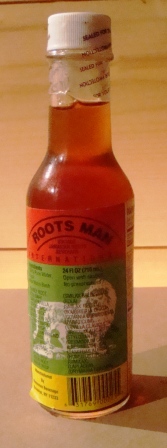
To atone for my blasphemous use of commercial yeast I added Roots Wine, at a rate of one ounce per gallon. These are legendary Jamaican tonic drinks, purported to increase vitality, strength, and “go-power” particularly among men.

The names of their root ingredients are wonderfully evocative: Tan Pan Rock, Search Mi Heart, Poor Man Friend, Nerve Wisp. Some drinks contain more than 20 ingredients, creating a complex flavor sensation.

Brands seem to come and go, with Baba Roots a recent market leader. Mandingo appears to be the latest drink darling. Of those I have tried “Natural Vibes” has been my favorite, but it is evidently out of production. In any case, the addition of a small amount of one of these tonics adds a mysterious background note to the ginger beer that combines smoky aroma with tart, tangy and sweet tastes.

While ginger beer made in this way ferments out very dry, it is far better when it has been sweetened a bit to taste. I have tried mauby syrup with good results. Agave nectar and raw sugar syrup also work well. Jah Guide Protek I&I.

Letenachin T’ej

t'ej2T’ej is an ancient Ethiopian honey wine flavored with the leaves and stems of a local thornbush known as gesho.

I can believe that fermented honey was the first alcoholic inebriant. It’s easy to picture a bee hive in a tree, leaking a bit of honey, soaked with a bit of rain, sitting for a couple of days, encountered by a thirsty traveler….

The leap from a drunk encounter to a full-spectrum beverage was certainly taken by the Ethiopians when they created T’ej:

The choice of honey was limited to wildflowers, and while this can sometimes be bland, some is very amber, and full-flavored. A t’ej maker can be sure that whatever wildflower honey is at hand, it’s sure to be authentic. Add the local spring water of your choice. It’s fun to get it from the local natural spring, but not necessary!

Gesho

T’ej comes out a nice gold color, slightly hazy. The aroma combines the flowery notes of the honey with wood, and an almost grapefruit smell from the gesho.

Bittering is also the work of the gesho, either twigs or ground leaves. The leaves and twigs have different flavors, with some recipes favoring one, some the other. From what I understand, the leaves produce a more “refined” flavor–whatever that means! I tried a blend of both. I found the flavor very refined, with honey mixing with citrus, woody bitterness and a residual sweetness. This t’ej has aged for four years, resulting in a light effervescence.

Roasted kolo grains add umami to this recipe, and netch azmud provides a trace of peppery spice. To increase the honey aroma the recipe calls for a small amount of tincture of propolis, which also serves to mimic the “throw the whole hive in” method of early honey wine production.

It finishes with tartness, and a mild alcoholic end. There are a lot of words for honey wine in Ethiopia–this is one of them! Letenachin!

Egyptian Bouza

Bouza

Bouza is the beer of the Pharoahs. As I see it, this was a rough beer, naturally fermented in vessels that “remembered” how to make it. I found a source for a sourdough yeast strain from a bakery in Cairo that has been in continuous operation for three thousand years. This was bouza in the making.

Bouza was made in a way that is unique in comparison to today’s methods. The key ingredient was bread–partially baked grains that would saccarify during the slow, prolonged baking process. Bouza bread is made from pale barley malt, crystal malt and barley flour that is mixed with gesho tea to make a stiff dough. A pint of Red Sea Starter is added to the dough, along with macerated medjool dates, honey, salt and netch azmud seeds.
Bouza Bread

The dough is shaped into round loaves, and left to proof for 12 hours. The loaves are baked at low temperature until the interior is hot and gooey. Cooled, they can be stored for some time before brew day.

Because much of the saccarification of bouza bread’s starches has been completed by the baking process, to brew, the loaves are crumbled into mash-temperature water and soaked for an hour. The liquid is drained off and the grains are rinsed with hot water. The wort is infused with blue lotus flowers, boiled and cooled. Sourdough culture is added, and the mixture fermented for three days at a temperature between 70F and 80F to taste (the higher temperature range favors the lactobacillus in the sourdough culture, making the bouza more tart.)

When the bouza has finished fermenting, it can be bottled with a small amount of honey in each bottle. This batch is very dark amber, with a sourdough bread aroma. The flavor is tangy, with hints of malt, pepper, corriander and nutmeg.

As it tends to ferment out very dry, and consequently sour, the bouza can be mixed to taste with date sugar for sweetening before serving it. Show up at the Pharoah’s pad with a jug of this, and you’re sure to receive a warm welcome.

Aged Chhaang

chhaangChhaang is the refreshingly tart, lightly-alcoholic drink popular in Tibet and Nepal. It seems to be a close relative of rice wine, although it can be made from rice, millet or barley, whatever’s handy. As I understand it, Tibetan chhaang is usually made from rice, and Nepali chhaang from millet. In the “whatever’s handy” spirit I used rice, millet, barley and wheat.

The fermenting agent in the Himalayas is a mysterious ingredient known in English as “yeast balls.” Evidently these are highly revered, and perhaps passed down in the family, though they are said to be available in ethnic grocery stores. I tried to find a source for them through the internet, and a Chinese variety is now manufactured by Toronto’s Onto Yeast Company. A bag sufficient for 10 liters of rice wine—if my simplified Chinese translation can be trusted—costs about $10. Sous Chef also sells a smaller bag online at considerably less cost, depending on where they ship to.

According to my research, Himalayan yeast balls are made with local ginger, grain flour, and water. The ginger is said to have the necessary organisms residing on it’s skin–yeast and Aspergillus oryzae . This fungus is able to convert the starches in grains into sugars without the need to sprout or malt them, and is used to ferment soy beans for tamari, and rice for sake.

I tried mixing shredded store-bought organic ginger with barley flour and water, formed this into cakes and proofed them for 3 days under a damp cloth. I got a smelly mess. I guess the ginger just isn’t the same. Probably too clean for one thing. So instead I steamed some rice, added koji-kin, and made myself a moto starter as I would for sake.

I mixed mold-coated rice with Windsor Ale yeast, known for its estery, fruity contribution to a brew. After three days this starter was nicely soupy, and so I added a culture of two strains of lactobacillus bacteria and let it ferment for another day.

The main mash consisted of malted barley, to which was added pearl barley, millet, rice and dark wheat, all of which had been boiled for 20 minutes in a ginger-root tea. This was mashed for two hours and cooled to room temperature. The moto starter went into the mash soup with all the grains, and fermented for three days.

Traditionally, the mash would at this point be placed in a bowl or mug, warm water poured over, and the drink sipped through a bamboo straining straw. More water would go in until the drink was too weak to continue. Because I wanted to keep the chhaang for a while, I strained it, bottled it, and kept these bottles refrigerated. At this time the chhaang has been aging cold for about 2 years.

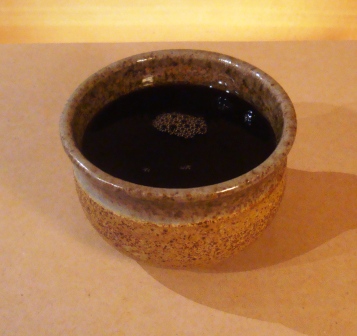
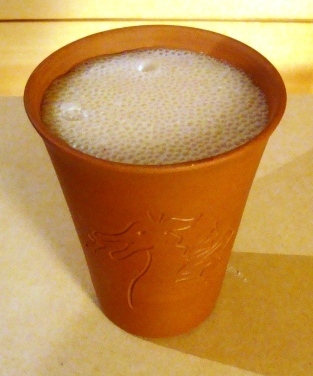
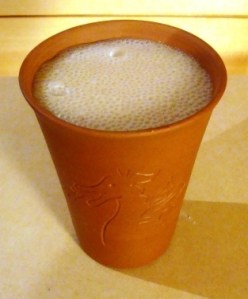
Aged Chhaang is a dark creamy color, opaque and has a nice layer of bubbles on the surface. The moto/koji/sake aroma is very prominent. It is very slightly sweet, with a mostly tart flavor. Sugar may be added to taste. Full-bodied and lightly carbonated, it finishes with a mouthwatering tang. I don’t know what Nepalese chhaang tastes like, but this one is certainly an interesting and mildly inebriating beverage. I would be proud to serve it to a visiting yeti.