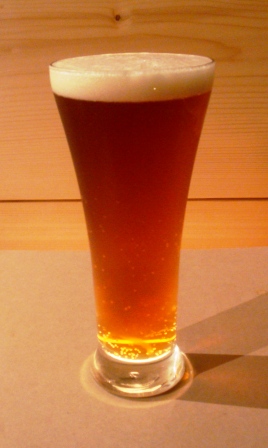
Oaked Burton Ale

Oaked Burton This is a heavy one, and definitely a keeper. I wanted a barley-wine-style ale that I could age for ten years, to see how it develops. Oaked Burton was brewed in August, 2008, and it’s maturing very well.

My original tribute to the legendary Ballantine Burton Ale, Oaked Burton derives its name from the tincture, made from a half-ounce of home-toasted oak chips soaked in Everclear, which was added to the secondary fermenter. Significantly, this addition boosts the ABV by almost a point, to about 9.4%.

Oaked Burton is a partial-mash brew that is based on Munton light DME. The mash was 2-row pale barley malt, with additions of four kinds of crystal malt, English brown malt, chocolate and black malts, and roasted barley. Burton salts and gray sea salt went into the boiling water. Maltodextrin adds body. To further boost body and alcoholic content, I added Lyle’s Golden Syrup and Malawi demerara sugar.

Hopped with Northern Brewer bittering, Golding flavor and Fuggle aroma varieties, it is only moderately bitter, with the malt components dominating its profile. The excellent White Labs’ WLP023 Burton Ale yeast contributed its uniquely mild fruity character.

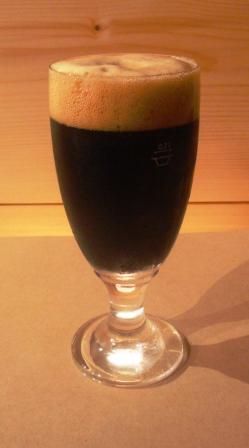
Oaked Burton pours a medium brown with hints of gold; almost an extreme amber. It has a tan, long-lasting head that leaves very little lacing on the glass. The aroma is malty, with hints of oak. The taste is of malt, with caramel, almonds and dark fruit like plum. Roasted grain, oak, and mild alcohol dance in the background. It finishes with a hoppy tang, oaky astringency and an alcoholic warmness.

No one is going to age a commercial beer for ten years these days. The era of the ancient barrel-aged Ballantine is over. But a home-brewer can certainly put a few bottles away for five years, and ten is only double that and well worth the wait–if you’ve got some West Coast Amber to tide you over in the meantime.

Lime N.D. Coconut

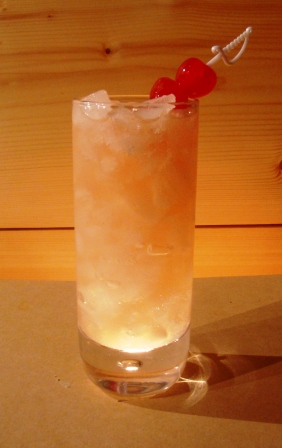
Lime N.D. CoconutLime N.D. Coconut is a soda that is also a health drink! N.D. stands for “New Dimension.” (It’s also a sideways hat tip to Harry Nilsson.) It is a new direction in taking the Umami Principle to soft drinks. It tastes like nothing I’ve ever had in a traditional soda, and qualifies as a true umami flavor bomb. It is also the most nutrient-packed tonic drink I’ve devised so far.

This idea started when a friend encouraged me to try coconut sugar, because it was delicious. I did, and it was. Much coconut sugar comes from Indonesia with Thailand also an important producer. This suggested to me a Southeast Asian flavor theme, one that might produce in a soda, perhaps the enjoyment that comes from a well-made Tom Kha Gai.

My formula for a full-spectrum soft drink calls for a juice, a root, an oil, an herb, a sugar, a berry, and an acid. Here’s how those ingredients combine for Lime N.D. Coconut.

Faddish coconut water seems to crowd the health-food section lately. High in potassium and other minerals, it’s the latest trend in hydration and tasty too. Twenty years ago on a Mexican beach I bought a green coconut, the top lopped off with a machete, for a few pesos. The water inside was sweet and refreshing. The Whale Watcher Bar in Cabo would put in a shot each of rum, vodka, tequila, gin and Pernod—a Coco Loco. Twenty years later, Thai coconut water seems to be everywhere.

Shredded coconut, not the baker’s kind, just plain, unsweetened meat, adds to the coconut aroma of the drink, with a good dose of glutamate as well. Coconut milk, made from shredded coconut meat and water, contains about 0.37 percent glutamate. The amino acid is the most abundant of those in coconuts.

Key limes are easy to get now too. Their juice provides acidic sourness to balance the sweetness of the coconut water and sugar. The key lime zest provides citrus oil aromatics on top of the coconut aroma.

Fresh, thinly sliced galangal, a rhizome reminiscent of ginger, but with a stronger, more peppery taste, is the root component, with strong medicinal properties. Galangal and lime juice are mixed as a tonic in some Asian countries.

Lemongrass is a well-known tonic herb from India, now widely cultivated in Southeast Asia. Lemongrass provides this drink with both an aroma of lemons and a taste mildly reminiscent of them, without the sourness.

Coconut sugar is produced in Southeast Asia, on organic palm farms. Creamy and caramally sweet, it’s drawn from the flower buds of cocos nucifera. Coconut sugar contains minerals, B vitamins, and a large amount of glutamic acid. Glutamine is the largest constituent among the 16 amino acids found in coconut sap sugar, more than double the amount of the next highest, threonine.

Goji berries (wolfberry) go into Chinese tonic soups and herbal teas. Some Chinese wines also use goji berries. They contain about 500 times more Vitamin C than oranges, and befitting an umami bomb, the ingredient glutamic acid. At the same time polysaccharides from wolfberry protect neurons against the overstimulative effects of too much neurotransmitter such as glutamate.

A garnish of Thai basil and Kaffir lime leaves creates an amazing cloud of distinctive aromatics surrounding the glass. While Lime N.D. Coconut is refreshingly complex in flavor, this healthful tonic can be further tweaked with a shot of white rum and a twist of lime. Served on the rocks it is a great summer quencher.

La Belle Creole Black Lager

La Belle Creole2I just opened my last bottle of La Belle Creole Black Lager. It’s three and a half years old, and it is magnificent. I like to make “tribute” beers, rather than clones. This is a tribute to Dixie Blackened Voodoo. I first saw a bottle in a liquor store in New Orleans. I had to try it out–I loved the concept.

The execution didn’t really live up to the idea. There are a lot of constraints on bringing a cool idea to market, and Dixie’s attempt was pretty one-dimensional. I wondered what the theme could produce without commercial constraints: La Belle Creole takes the “Voodoo Brew” idea quite a bit further into the bayous.

Central to the voyage is the Voodoo Spice that goes into it. This is a mixture of primarily French Roast coffee, with chicory added in the style of New Orleans’ French Market. Smaller additions of other spices create a complex blend of flavors: cubeb berry, sassafras bark, gumbo file, sarsaparilla root, licorice, paradise seed.

La Belle is based on Munton’s light DME, with an addition of plain and home-toasted Munich malt. A blend of four crystal malts, chocolate malt, black malt and roasted barley provide the dark color and flavors. Noble hops in the lager tradition, including Northern Brewer, Tettnanger and Perle provide bitterness and hop flavor.

Starting gravity was 13.75 degrees Plato (1.055) and the beer finished at 4 Plato (1.015).

The amazing San Francisco lager yeast (White Labs WLP810) offers a connection to that other American Voodoo sea port, fermenting the brew out dry yet flavorful. The Voodoo Spice addition kicks it up a notch. To add the spice I crushed 12.5 grams of the mixture in a mortar and soaked it for 13 days in 120 ml of 190 proof Everclear ethanol. Filtered, this potion went into the secondary fermenter: enough Juju to boost the alcohol content by 0.5 percent.

This is a very dark, but crystal clear ruby beer with a tan, frothy head. The caramel and roasted coffee nose also offers light notes of chocolate and sassafras. Full-bodied in the mouth, the flavors dance between rooty, resiny, herby and toffee. The Everclear has nicely blended into the Voodoo spectrum. Mild bitterness finishes with roasty malt flavors.

I don’t usually make labels for my beers but this one was destined for some gifting, and so I did. La_Belle_Creole_labelI went looking for pictures of Creole Belles, and found a great one in Wikimedia Commons. It's an 1890s lithograph cigar box label, a brand manufactured by Hernsheim cigar factory, Magazine Street, New Orleans. I just love this sweet lady with a giant silver crucifix on a ribbon around her neck. That's Belle Creole style.

I can imagine what it would have been like jazzing around the French Quarter back in those days. But I’m pretty sure this Creole Belle’s daddy would not have let me get near her with my Voodoo Spice.

Ruby Gush

Ruby Gush I’ve never been a fan of cola drinks. I’ll have one occasionally, but never understood how my cousin can have a Pepsi instead of her morning coffee. For as long as I can remember the tart/sweet drinks have been my favorite. My earliest recollection of this goes back to the time my Dad was buying his brand-new 1954 two-toned Dodge sedan. There was a pop machine that sold grapefruit-flavored Squirt in the dealership. Dad bought me one. I loved it.

The grapefruit is a hybrid of sweet orange and pomelo, developed in Barbados (where great rum is made, but I digress.) When I was growing up, yellow grapefruit halves sprinkled with sugar were a staple on our breakfast table. These have been almost completely replaced in the marketplace by the ruby variety, for good reason.

The ruby grapefruit has a distinctive smell, and a taste sweeter than the yellow grapefruit.
When our family recently acquired a case of Texas ruby grapefruit as part of the school band fund-raiser I decided to make a soft drink reminiscent of the Squirt I used to love.

Ruby Gush starts with 1.25 liters of grapefruit juice and the zest from two grapefruit for a 4 liter batch. I let the grapefruit rest in a cool room for two weeks to develop the flavor. To the juice I added 400 grams of evaporated raw cane juice. Next came 12.5 grams of fresh grated ginger, and 1.5 grams of lemon balm. I heated the syrup to steep out the flavors, strained and pasteurized it. I measured 150 ml into each of eight 500 ml swing top bottles, froze these, then topped them up with carbonated water. A total success, Ruby Gush is better than Squirt, though I remain enamored of the memory. Tasty indeed, I might even try adding a shot of spirits to the glass to make a Ruby Greyhound or even a Red Dog.

Regis X Gruit Ale

Gruit
The first thing to understand is that gruit is not beer as you know it. It might be “beor” but to expect a beverage that tastes like modern beer is to be surprised when first tasting gruit ale.

From Medieval times up until the 1600s “ale” referred to a fermented beverage that used herbs other than hops for flavoring and preservative properties. The term “ale” itself had connotations in those days of sorcery, magic, intoxication. “Beer” was a drink that came from the Low Countries, where the brewers used the flowers of the hop vine to flavor and preserve their malt liquors.

Gruit refers most specifically to a mixture of herbs that were traditionally used to make ale. And as “ale” implies, these herbs were likely chosen first for their inebriating properties. Today, inebriation is usually thought of as “drunk” or “intoxicated.” And while a traditional gruit ale was no doubt brewed to be strongly alcoholic, the herbs infused into the beverage were strongly psychotropic. The number of plants with psychoactive properties runs to the hundreds, so it is no surprise that over time, experimentation came up with some interesting combinations.

All this is to say treat gruit ale with respect. Drink enough and you will get drunk. But you will also get something else–exactly what that is, is hard to say. It’s not “stoned.” It’s not “wasted.” It’s “inebriated.”

The earliest surviving recipes for gruit call for marsh rosemary, sweet gale and yarrow as herbal ingredients. They are used in small quantities compared to the amount of hop flowers typically used in a batch of beer.

The first batch of gruit ale I brewed followed the basic recipe uncovered by the members of The Durden Park Beer Circle in England. The recipe dates from around 1300 AD and makes an ale of perhaps eight percent alcohol or so. It calls for pale and Carapils malts, as an acceptable substitute for the kind of malted barley that was used in Medieval times–a wood-fire-cured product that was probably an amber or even brown color.

This ale was nice, but a bit uninteresting to my palate. I decided that I would do a batch that was quite a bit darker and richer, taking advantage of the caramel and dark malts now available. These were introduced in the case of dark malts after the invention of the drum roaster in 1817, and with the process for producing caramel malts around 1850. I started with 2 kilos of pale malt, 400 grams of crystal malt and 150 grams of Carapils for a 12 liter batch. To these I added Munich malt, bicuit malt and Special B; chocolate malt and roasted barley.

I also took some time to research the many other herbs used for ale-making, and settled on a combination of the previously mentioned three, plus mugwort and heather. One-third of the dose went into the mash, another third into the boil. The final third went into the primary fermenter in a hop sack. I pitched White Labs WLP028 Edinburgh yeast for it’s great performance in malty, strong, complex ales.

The early recipes probably used Ledum Palustre as the “Marsh Rosemary” ingredient–an herb hard to come by. In fact, in ancient times it was possible to pay your taxes with marsh rosemary. For the initial brewing of this batch I substituted the closely-related “Labrador Tea” leaf. I also added a good dose of sweet Sedona juniper berries.

After five days brewing I removed a half-liter of the ale, heated it, and steeped 9 grams of heather flowers in it for 20 hours, strained it and returned it to the fermenter. In a bit of luck, my herb supplier came upon a source of genuine marsh rosemary, and I dry hopped the brew in the secondary fermenter with 10 grams of this.

It’s hard to imagine that gruit ales were originally carbonated, although the term “head,” referring to the foam on top of a glass of beer, is first found in use around 1540. Nonetheless, I chose to carbonate this batch, and put it up in 750 ml swing-top bottles.

The Regis X Gruit Ale is now two years old. It pours a dark brown with a light tan head. The aroma is indescribable for me, as I’ve never encountered anything similar. Herbal of course, piney, woody, perhaps even tangy. It has a moderately heavy body. The flavor is reminiscent of grapefruit, somewhat sour in a citrus way–definitely not lactic or acetic. The finish is quite bitter.

Commoners” that have tasted Regis X have found it interesting and compelling. It is fully a gruit, not beer as we know it. It’s important to gauge consumption carefully. Though it is very tasty, the herbs are definitely psychotropic. The best way to describe the sensation is “Whoa!” Don’t drink more than a pint of it before you know where you’re going.

Scott likes it, and so does his wife Jody. Thanks for the bombers Scott, and bring my swing top back!
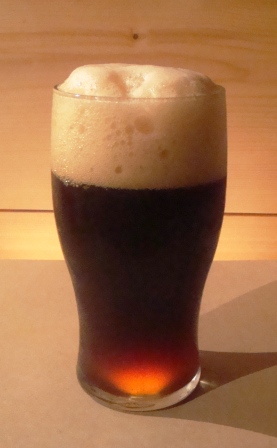
Sparkling Meyer Lemonade

Meyer Lemonade
Some recipes are a description of a state of mind. Sparkling Meyer Lemonade is one of those. Meyer Lemonade. To me that recalls the dwarf lemon tree Mom had in the back yard. When we moved to California from Ohio, things like year-round bearing citrus trees were a wonder. Mom said the best tasting lemon was the Meyer, a cross between an ordinary lemon and probably, a Mandarin orange, and that was the variety she planted first.

Mom was right. Cuisinistas like Martha Stewart and Alice Waters discovered the Meyer lemon a while after Mom did. Dad would pick 20 of them, perhaps some time around July, cut them in half, mash them in a bucket, add sugar, ice, water, and a good handful of the fresh mint that also grew abundantly in the wondrous California garden. The aroma was spectacular.

The taste was also refreshing, more tart than the concentrate that came in the six-ounce cans of the day. That thought reminds me of Schweppes Bitter Lemon, a lemon-quinine tang that I came to love perhaps 20 years later than those backyard picnics. Alas, it appears that Bitter Lemon is not made any more. I thought I’d make my own.

First of all, there is the joy of fizz, and that is accomplished using the frozen syrup method for mixing sparkling water with juice and sweetener. Secondly, this recipe furthers the idea that a good soft drink should contain a juice, a root, an herb, an oil, and a sugar.

Sparkling Meyer Lemonade starts with 150 ml of Meyer lemon juice per liter of lemonade. Before squeezing the lemons I peeled the zest from 6 per liter (about 5 grams) and set that aside. The sugar is 100 grams per liter of evaporated raw organic cane juice.

For the root, this recipe has 3 grams per liter of ginger. The herb is 0.3 grams of lemon balm per liter. I heated the juice, sugar, herb, zest, and root to infuse and pasteurize the ingredients, and let them cool for 12 hours. I strained the brew, pasteurized it again, cooled it and dispensed 115 ml of the syrup into each 500 ml swing-top bottle. After I froze these bottles I topped them up with carbonated water, and kept them cold.

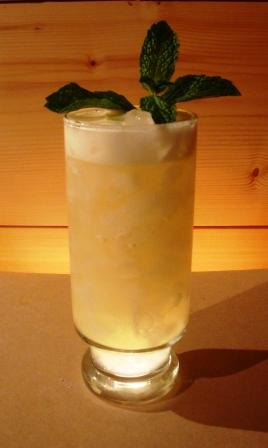
This drink is Huckleberry Finn meets Dom Perignon. Aging it in the fridge really makes a difference. Less than 0.3 percent alcohol I estimate, but still full of a richness coming from the raw sugar, the herby, citrus aromatics, the mandarin-meets-lemon flavor and the tingle on the tongue that Huck rarely if ever tasted.

Cool Rooster Malt Liquor

CoolRooster234 OK, I drank all the Cool Rooster. That’s why there’s no picture of it. But the brown bag is also a tribute to sultry summer nights sitting on the stoop in front of a Brownstone, in a city somewhere from Boston to St. Louis to Atlanta. I never did that, but I hope I can relate.

A few years ago I was in a Washington DC liquor store, and picked up a can of Coqui 900 malt liquor. I admit, I bought it for the name. It turned out to be an acceptable brew, not worthy of the bad reputation American malt liquor usually carries. This got me to thinking, “What if they brewed malt liquor to taste great, not as a cheap drunk?” I was on a quest.

I looked over my collection of beer cans and sought further inspiration: Magnum Malt Liquor; Golden Hawk Classic; Country Club. Finally, I turned to one of my favorite Saturday Night Live skits: Cold Cock Malt Liquor, featuring Tim Meadows as the urbane host of a serious party. Ellen Cleghorn tells him “You one malt liquor picker!” Chris Rock gets socked in the chin by the label art and declares “Proper!” I wanted to make a proper malt liquor.

The literature says American malt liquors are distinguished by malty sweetness, with medium body and light bitterness. They should be pale gold in color, with a modest hop flavor and a little “skunky” nose. Like many light American beers, malt liquor has a substantial amount of corn sugar, rice solids, or flaked corn; in this case they’re used to bring the ABV up to about 8 percent.

Cool Rooster starts with 750 grams of pale barley malt, together with 450 grams of flaked corn, 250 grams each of honey (aromatic) malt and 10L crystal malt, 100 grams of Cara-Pils, and 15 grams of black malt. These are mashed with the single-step infusion method. Then 2.7 kilos of Munton dry malt extract, 410 grams of corn sugar, and 450 grams of rice solids are added. The boil is bittered with 20 grams of Chinook hops, flavored with 15 grams of Liberty, and 15 grams of Centennial hops. The boiled wort is topped up with filtered water to make a batch of 23 liters volume. Starting gravity is 17.5 Plato.

For this brew I pitched Safale US-05 . This is an American ale yeast with a high tolerance for alcohol, producing a very clear beer with a nice crisp balance, and a creamy head. The beer fermented out to 2.75 Plato, indicating a finished ABV of 8.4 percent. Six months aging really smoothes it out.

Cool Rooster is a strong gold color, with a white firm head. It has a malty nose, with a slight hop aroma. Its smooth flavor does not feature much of the corn addition, finishing fairly dry with a tasty bitter touch. A nice example of real American Malt Liquor’s style, Cool Rooster packs a punch–Proper!

New Creston Barrel Cider

Creston Barrel Cider New Englanders of the 17th and 18th Centuries were known for their consumption of prodigious amounts of rum. Less expensive and easier to come by were large quantities of apple juice, from nearby orchards. But the modestly alcoholic beverage made from fermenting pure apple juice was unlikely to satisfy the jaded palates of the aldermen. Faced with the prospect of imbibing a mere 5% ABV, New Englanders resorted to various adjuncts, including sugar, raisins, molasses, and honey, which, upon fermentation, would raise the alcoholic content of the drink to a more respectable 10 percent or so. This they would age in oak barrels, with perhaps some handfuls of wheat, which would moderate its taste “be it harsh and eager.”

New Creston Barrel Cider is so named because the apples come from the Creston Valley of British Columbia. Creston is known for the wide variety of apples grown there, and this is a key factor in the making of superior cider. When I first started making hard cider I would buy a few gallon jugs of apple juice from the likes of Trader Joe’s and Whole Foods, pitch some yeast, wait a while, and decide I really didn’t like hard cider very much.

Then I discovered blending. Mixing the juice from several varieties of apples creates the full-spectrum experience that is typical of complex recipes. In the case of hard cider, the blend of juice should include sweet, tart, bitter and aromatic apples. For traditional barrel cider, the sensation of umami can be created with an addition of grapes and grains.

New Creston Barrel Cider starts with a blend of Jonagold (tart), McIntosh (aromatic) Spartan and Gala (sweet) apples. To add umami I took 25 grams of Sultanas and 25 grams of Malawi “Sucre de Canne Brut” per liter of juice, added 12.5 grams per liter of cracked dark wheat malt, and simmered these in South African Muscat grape juice for 20 minutes. I added this mash to the fermenter, and noted that it would make a terrific breakfast cereal!

I’ve recently found that unpasteurized Creston apple juice will ferment nicely with its natural yeast, but it can be a risky proposition with unpredictable results. For this batch I pitched a starter of White Labs WLP720 Sweet Mead yeast in malt powder with a little yeast nutrient.

As barrels are a pain to use and maintain, I’ve added barrel flavor to other batches by using French oak chips. For this version I left them out. Instead, when fermentation was complete and the cider well-aged, I added crab apple syrup made with equal parts of crab apple juice and sugar. This gives the cider the tannic, bitter principle of a full-spectrum blend, with a semi-sweet flavor. With three years of aging, it’s a beautiful cider, with a lovely apple aroma, super clear, sweet, yet still tart. The sultanas give it a moderately full body, and the wheat provides a soft finish. Luscious.

Orange Twichell

jigger The concept of full-spectrum fermentation and the incorporation of umami-producing flavor sensations in beverages suggests that these concoctions should be balanced in character. The concentration of complex tastes and aromas exist for each creation in varying amounts depending on the nature of the drink.

Orange Twichell is an example of a fermented beverage that is extremely low in alcohol–so low in fact as to be considered “non-alcoholic” under the law. Actually, it contains something between 0.1 percent and 0.3 percent alcohol, and at that level the body metabolizes it faster than it can be consumed.

Naturally occurring yeasts and bacteria live on the skins of fruits, a fact experienced in ancient times when humans felt kind of funny after drinking grape juice that had been sitting around for a while. Oranges, in this case, contain about 0.1 percent alcohol when they are picked, and this rises during the time they are stored.

A couple of years ago in a specialty store I came across an attractive bottle labeled Fentimans Orange Jigger. I bought a bottle and tried it out. It was nice, but expensive. I thought I’d try to make my own. It turned out nice too, and quite a bit less costly. The idea was to create a balanced drink combining sweetness, bitterness, sourness, saltiness and umami.

The ingredient and nutritional labeling for Orange Jigger contains plenty of clues to its composition, and a look at the Fentimans website provided more information. There’s Mandarin orange juice in Jigger, and as I recall Seville orange juice too, although the drink is now described as having Seville Orange zest in it. The label also mentioned ginger, juniper berry, and speedwell. The nutritional information told me how much sugar was in it.

It was enough to have a go at it, and even make some tweaks along the way. My recipe starts with 30 percent fruit juice. The trick to this blend is to wait around until the Seville Oranges and Mandarins come into season, around January or February in the Northern Hemisphere. Mandarins are easier to come by during the rest of the year, but to make Orange Twichell in June I need to squeeze and zest the Sevilles and freeze the result.

The Fentimans website suggests that its beverages are fermented with brewers yeast. I tried brewing with ale yeast and wine yeast for a couple of batches but I found the yeasty flavor overpowering. For my latest batch I tried a different approach. I let the oranges sit in cool storage for a week, then squeezed them and refrigerated the juice for another four days. This resulted in a more subtle flavor change.

I needed a few tries to settle on the right amount of ginger and juniper too. For the ginger about 2.5 grams per liter of finished drink seems about right to me. Raw ginger contains about 2 percent protein, enough to give the umami sensation a bit of a boost. It also contains potassium, for a very subtle salt taste.

The juniper berries are an interesting story. I’ve tried the commercially available ones with success, but the best so far were ones that I happened to have picked in the mountains behind Sedona Arizona, quite on a whim. They’d languished in a bottle in the spice cabinet for 25 years when I rediscovered them. They were still in perfect condition–soft, spicy, and intensely sweet. The piney characteristic of fresh berries had turned into more of a citrus flavor.

The “speedwell” addition took a bit of research. I’d never heard of it, but it turns out to be a common botanical in England. Almost a weed, Veronica Officinalis seems to grow everywhere. I couldn’t get any, but the local nursery had the related ornamental variety Veronica Spicata. I grew some, dried the leaves and used about .25 grams per liter of finished beverage. In the intervening years I’ve tried both and I find the Spicata flavor much nicer.

I took all the ingredients plus organic evaporated cane juice (another source of glutamic acid) and heated the mixture to steep out the flavors, strained out the berry husks, shredded ginger and citrus zest. I reheated it to pasteurize the juice and let it cool. I dispensed 150 ml of the juice blend into each of 20 half-liter swing top bottles and put these in the freezer. When the juice was frozen I topped the bottles up with carbonated spring water. I keep the bottles chilled until I’m ready to serve the excellent results.

A note on the name: If Fentimans has not trademarked “Orange Jigger” they should, as it is a great name. Fentimans says “jigger” refers to an old English term meaning “good measure.” Seeking a name that would suffice while respecting the Fentimans brand, I saw that “jigger” can also refer to an alleyway in Liverpool. In Nottinghamshire an alleyway is commonly called a “twichell.” I liked the word twichell, so there it is!

Northwest Pale Ale

NWPA I picked up a bottle of Deschutes Red Chair NWPA on a trip through Spokane, Washington, intrigued by the nice label art, and by the brewery’s claim to have created the first Northwest Pale Ale. I’ve never had a Deschutes beer I didn’t like, and the neck ring copy–offering a plush, satiny experience featuring “edges out, layers in”–sounded promising.

Tired of in-your-face, over-the-top hop madness, I decided to check it out. I was not disappointed. Eager to join the NWPA trend, I figured the skiing metaphor suggested a beer that turns agreeably, with a smooth ride featuring layers of citrus, tropical fruit and a malty finish. The label mentioned seven European and North American malts. ABV was 6.2%: assertive, but not the alcoholic blast of some of the runinators.

The Deschutes website now offers a recipe for a Red Chair clone, though it is very light on details. There’s only six malts mentioned, and the hops are Centennial and Challenger, not my idea of tropically fruity additions. Last fall I made up my own recipe, and I believe I came up with a version that nicely represents Northwest Pale Ale.

I started with Briess DME plus some Belgian extra dark aroma sugar and dark candi sugar. I steeped six kinds of crystal malt together with touches of chocolate wheat, cara-aroma, cara-pils and melanoidin malt to put a hint of redness in the color. As I was brewing in early September, I had a chance to try out another West Coast innovation: wet hopping. I used freshly-harvested homegrown Nugget, Willamette and Fuggle hops, added continuously during a one-hour boil.

I pitched White Labs’ WLP 090 San Diego Superyeast for this one, because of its clean flavor profile and relatively high attenuation. I wanted an emphasis on malt and hop aromas and flavors, not yeastiness. The beer started at 13 Plato.

After six days I racked the beer into a carboy and added 6 grams of sea salt. Ten weeks later I added 14 grams of Citra pellets to the carboy, and let it rest for a month and a half.

Finishing at 1.25 Plato this is a dry beer with nice overtones of malt and grapefruit. It pours a golden amber with hints of red. A modestly creamy head drops after a few minutes, leaving lacy patterns on the glass. The aroma is dominated by grapefruit to my nose, with a suggestion of passionfruit. Moderate body, a fruit burst on the palate without a full-on hop assault, and a malty finish. I had one after skiing yesterday–well worth the six-month wait!