Tracing the Roots of California Craft

I was raised in the San Francisco Bay Area, about 5 miles from Stanford University campus in Palo Alto. At that time Stanford had an agreement with the city that there would be no bars or liquor stores within a certain distance from the campus. But this arrangement didn’t apply to the next town over, Menlo Park. So, very close to the campus, there were two beer and burger joints that were big hangouts.
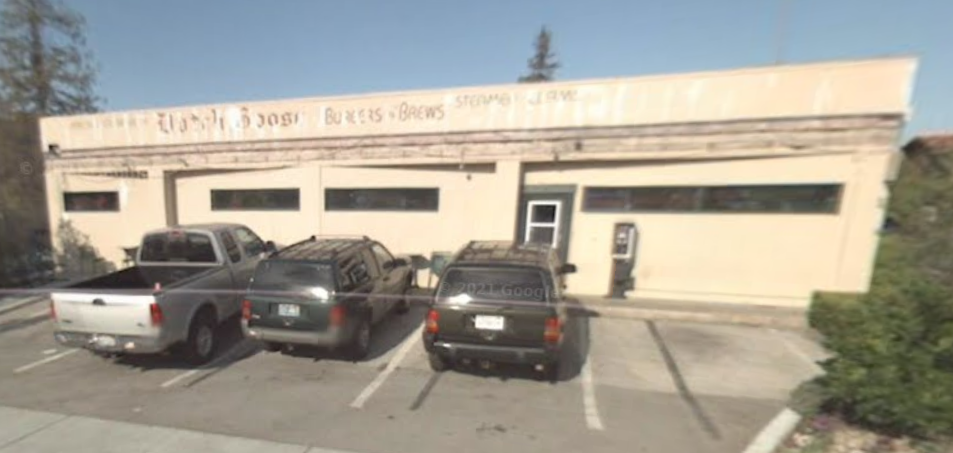
The Dutch Goose as it would have appeared to Fritz Maytag

These were The Dutch Goose, on Alameda de las Pulgas, and The Oasis on El Camino Real. Both of them served draft Anchor Steam Beer. (The Goose is still there, much gentrified, but The Oasis is sadly gone.)

The Oasis, shortly before it closed


In 1968 though, Anchor Steam was amazing. I soon discovered another place that served it in San Francisco: The Old Spaghetti Cafe and Excelsior Coffee House in North Beach. (The original, not the chain imitator.)


The “Spag Fac” was actually an old spaghetti factory filled with antiques. A full dinner could be had for $2.25. For this reason it had been a favorite hangout of hipsters and beatniks for years, and they poured Steam beer from Anchor’s ancient Golden Gate style kegs. I hung out there too, with a pint or two before a folk music show at Coffee and Confusion around the corner.

The Old Spaghetti Factory

I was hooked on good beer, but it was expensive. A bottle of Guiness could set you back more than fifty cents in 1973! At that time a half a buck could buy two gallons of gas!
So as a UCSB student with a taste for good beer and no money, I was intrigued when I discovered a Santa Barbara store called Wine Arts, and saw that they sold beer making supplies. The proprietor was very helpful, and sold me a book by home brewing pioneers Stanley Anderson and Raymond Hull. For ingredients I bought two cans of John Bull Extract, a pound of crystal malt, Fuggles hops, and Vierka Munich yeast. Following the instructions from the book, I ended up with a beer that tasted very much like Anchor Steam! This started my 50 year love affair with craft beer.
When I moved back to the Bay Area, I found that others shared my passion, and soon home brewing stores started to appear in towns like San Jose, Morgan Hill, Los Altos, and Palo Alto. There I found an Englishman’s guide to beer brewing to add to my library.

In liquor stores I started to see Anchor Steam in bottles. Brands like New Albion, DeBakker, Golden Bear, Palo Alto Brewing, and Pete’s appeared next to them not long after. Most of these are long gone, some due to undercapitalization, others due to mismanagement. Their proprietors were, after all, home brewers with little business operation experience. (It’s worth noting that home brewer Pete Slosberg chose to contract the brewing of his Wicked Ale out to August Schell Brewing in New Ulm, MN, making it widely available.)

The owner of the home brew supplies store in Chico, however, showed how it was properly done. Ken Grossman’s secret to success: learn how to do everything in an industry where there were limited supplies, equipment, and talent. Then work 12-hour days, seven days a week, for 20 years. Bring the kids to the brewery on Sundays to play among the piles of equipment and materials. Simple! Thus was born Sierra Nevada Pale Ale.

Fritz Maytag, meanwhile, was also showing the industry how it was done. As a Stanford student Fritz haunted The Oasis and Dutch Goose, where, despite its inconsistency he learned to love Anchor Steam Beer. When he heard the company was failing due to falling sales, he bought the place! As the story goes, Fritz was eager to update the Steam Beer recipe, and was visited first by a salesman offering him samples of a new type of crystal malt, and then by one who suggested Northern Brewer hops. He incorporated them both into his new recipe. With its success assured, Anchor Brewing moved to the former MJB coffee roastery, a wonderful Art Deco edifice in the Potrero District of San Francisco.
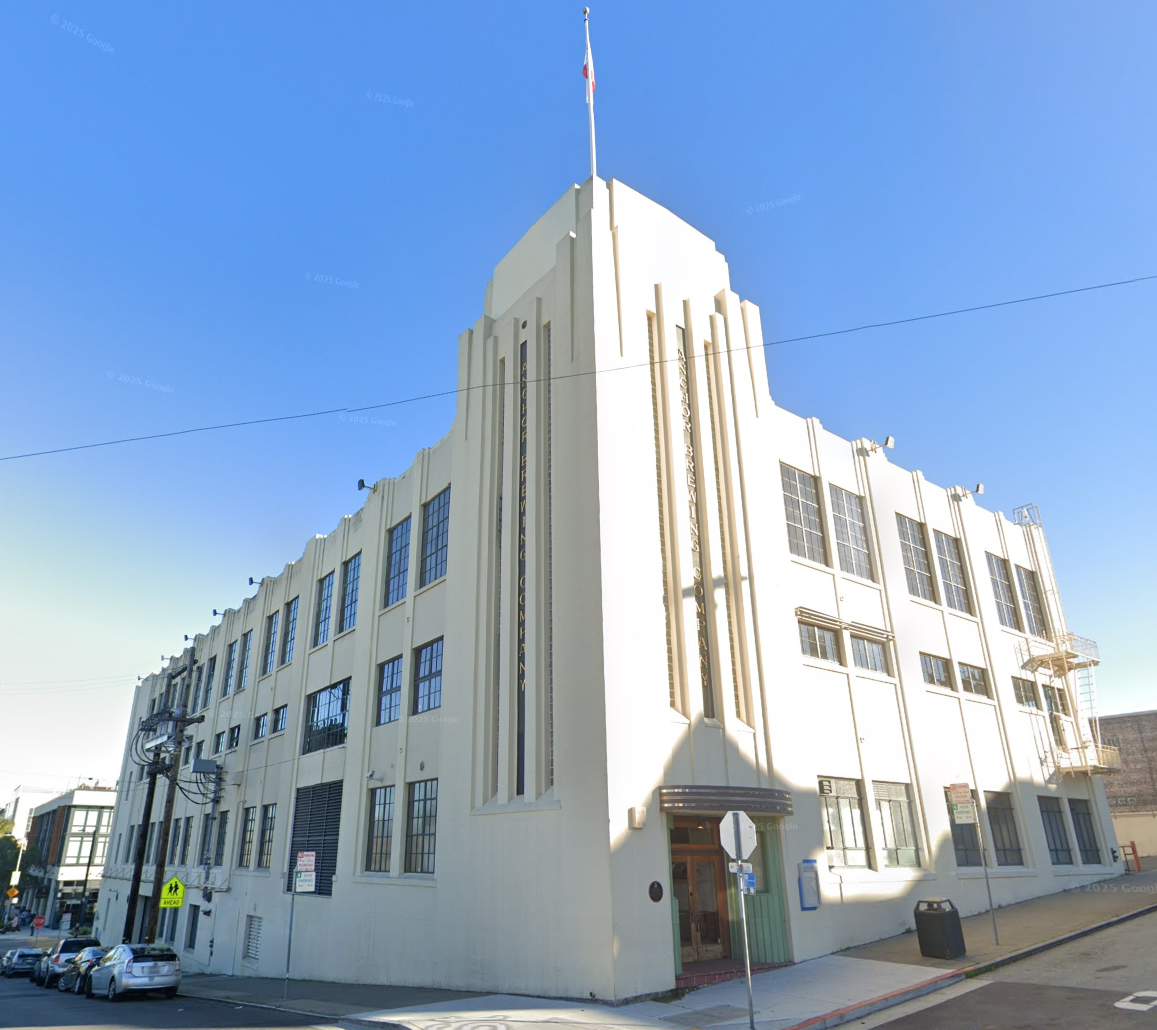
I visited the by-then well-established brewery in 1985. The place was a veritable museum of San Francisco brewing history. There was lots of Anchor breweriana, as well as signage and artifacts from SF breweries of the past. We didn’t get to meet Fritz, but we saw his lab, and it was clear from that how dedicated he was to maintaining the quality of his brew.
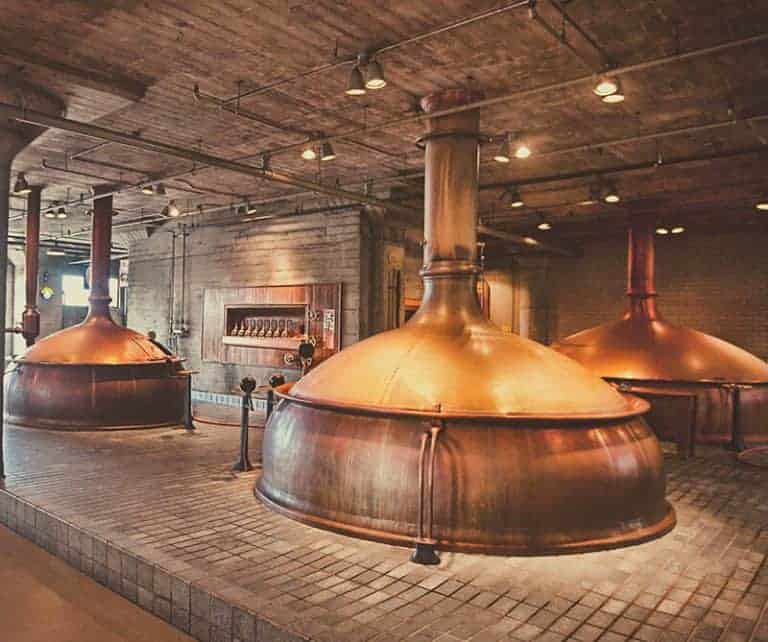
We saw the incredibly beautiful all-copper brewhouse he’d imported from Germany. We saw the antique bottling line, and the filling equipment for Anchor’s 1950s Golden Gate kegs.
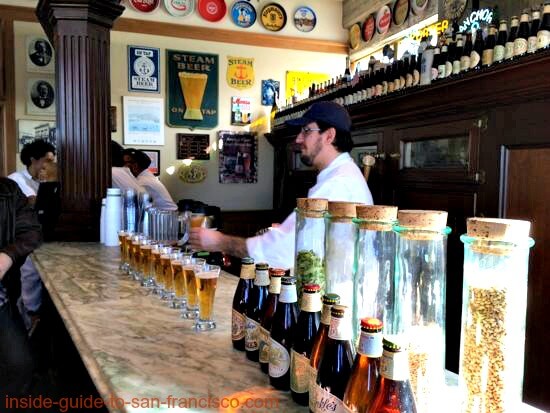
But the best part of the tour was Anchor’s tasting room, centered around an ancient bar from San Francisco’s Barbary Coast past. On this Winter Solstice afternoon in 1985 the sun poured through the clerestory windows behind the bar, and lit up the dark amber and ruby highlights of my glass of Old Foghorn barley wine. It was a moment I’ll never forget.

Epilogue: I recently had a chance to taste an Old Foghorn that had been cellared for 25 years. It was magnificent, a true testament to the meticulous care that Mr. Maytag applied to his brewing.
We compared it to a similarly aged pony bottle of Old Crustacean from Rogue Ales that had definitely seen better days. Thanks Fritz!
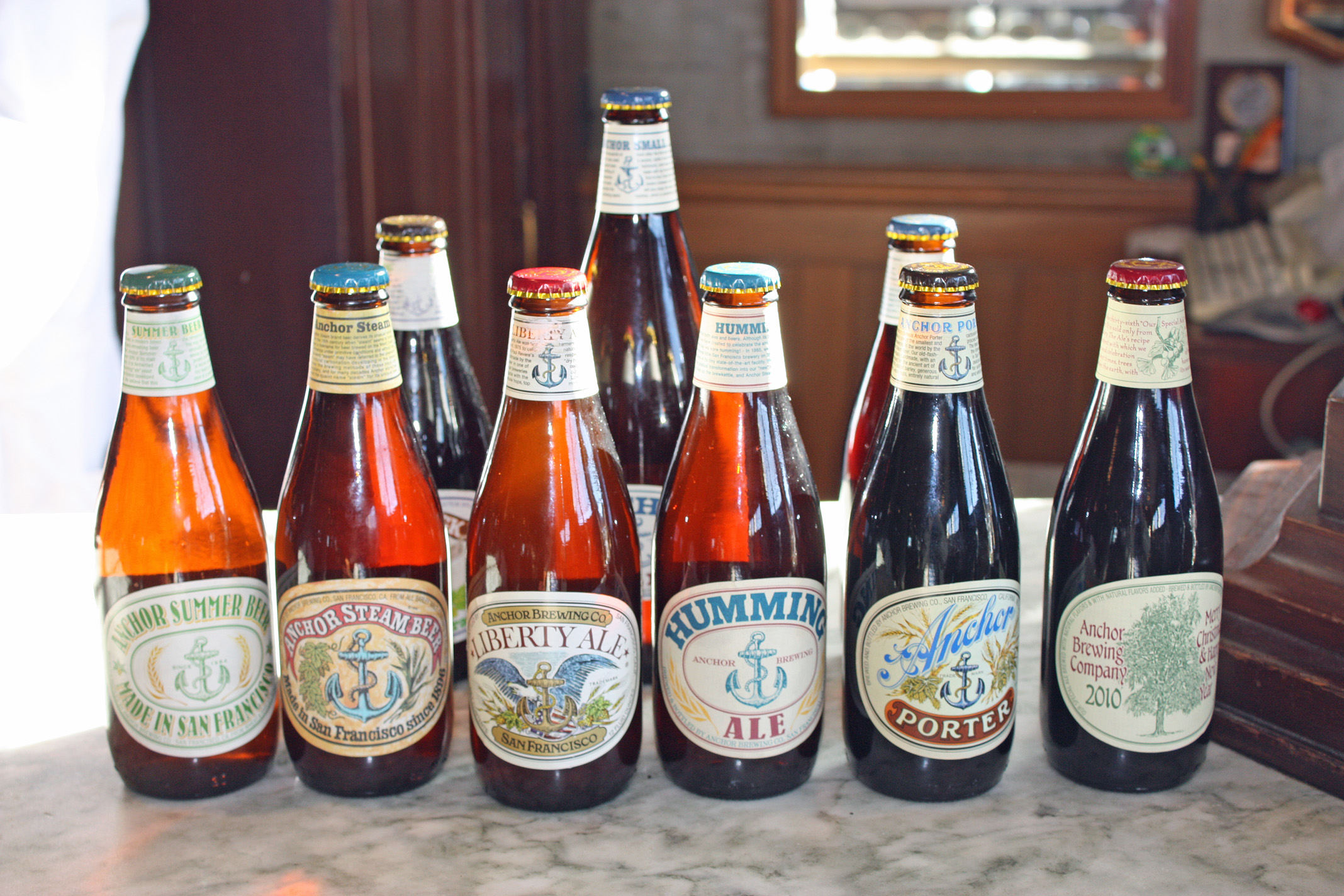
Update The Anchor Brewing Company, closed since 2023, has had it’s intellectual property, assets, brands and real estate purchased, and pending the resolution of some structural issues in the building is slated to reopen some time in the near future, hopefully before the end of 2025.

Cascadia Nation Black Lager

cascadia-black-lagercThe Cascade Mountain Range extends from Southern British Columbia through Western Washington and Oregon, into Northern California. Part of the Pacific Ocean’s “Ring of Fire” its highest peak is the volcano Mount Rainier. To its west are the hipster havens of Seattle and Portland, famous for some of the finest craft beer in the world. To its east lies the fertile hop growing region of the Yakima Valley in Washington. South of Portland, at the western edge of the Cascades, another stretch of fine hop farms fills the Willamette River valley.

The Cascade Range and its surrounding hop and barley farms form the mythical country of Cascadia. A generous cartographer would include the barley-growing regions of the Columbia Basin, and the Palouse, stretching east and south from Spokane, Washington. It also makes sense to declare San Francisco an honorary member among Cascadia cities, for it is the birthplace of the modern craft beer movement in the United States, thanks to the visionary efforts of Fritz Maytag and his Anchor Brewing Company.

Grain harvesting in Whitman County, Washington

Grain harvesting in Whitman County, Washington

The strains of hops developed in Cascadia, fittingly often begin with the letter “C” themselves. The “Four C’s” as they are sometimes called, are Cascade, Centennial, Chinook and Columbus. More recently Citra ™ has joined the group. They are dominantly bright, piney, citrusy and resinous in taste and aroma, and form the basis of most American India Pale Ales. Recently, they have been incorporated into a style known as Cascadian Dark Ale.

As hop and barley production began to ramp up in Cascadia during the 1980s, another development took place 180 degrees away in the Ring of Fire. Japanese brewers were early to recognize the potential for product differentiation offered by creating all-malt lagers in their commercial operations. Kirin and Sapporo led the way with premium “black beer” (黒ビール), featuring roasted malts and a sweet finish.

The Cascadia Black Lager shown here pays homage to both sides of the Ring of Fire. It is hoppy (40 IBU) like a Sierra Nevada Pale Ale, slightly roasty like a dark ale, with mildly sweet maltiness like Japanese black lager. It uses the San Francisco lager yeast to keep the finish drier than a typical ale. Cold-infused specialty grains, including debittered Carafa II, Munich malt and Breiss Special Roast maximize flavor while keeping away excessive burned harshness. A nice thick head leads to a moderately full mouth feel, and its 5.7% ABV is assertive, while keeping it well within the range of sessionability for the discerning and determined tippler!

FAQ: AKA The Umami Factor Elevator Pitch

Umami Factor_front1w

WHAT IS THE UMAMI FACTOR?

It’s two things. It’s the title of my new book, and it is the principle for making fermented beverages that provide a complex, mouth-filling, satisfying flavor sensation by balancing multiple aromas with the five tastes: sweet, sour, bitter, salty and umami.

WHAT IS UMAMI?

Umami is the taste sensation of savory foods. The word is Japanese for “delicious” taste. It’s provided by receptors in your mouth, throat, esophagus, and even stomach that detect the presence of glutamates, which are derived from amino acids. The umami sensation is pleasant for the same reason that “sweet” is pleasant.

The body is cued to detect vital, high-engergy nutrients: carbohydrates with sweet taste, and proteins with umami taste. Natural, unfiltered fermented beverages are packed with umami-producing compounds from the fruits, grains, and yeast they are made of.

WHAT IS FULL SPECTRUM FERMENTATION?

Full-spectrum fermentation describes a process of techniques combined with intricate ingredient formulas that create complex flavor arrangements evoking the response “There’s so much going on there! How did you do that?”

Full-spectrum beverages are complex and improbable, but ultimately well-balanced drinks.

coachandsix
WHY IS THIS BOOK DIFFERENT?

It takes a full-spectrum look at beverages from soft drinks to hard liquor. It thoroughly discusses the components necessary for flavor balancing. It examines related spectra, such as the inebriation spectrum and the commitment spectrum. It has a textbook approach to data, with a multitude of tables for ingredients and supplies. It provides recipes and detailed instructions, but more importantly it is a call to chefdom for aspiring fermentation artists. Tally Ho!

Buy The Umami Factor now for a substantial pre-release discount here.

Germano-Bohemian Lager

GB PilsPWGermano-Bohemian Lager marries the idea of rich, full Bohemian Pilsner with the crisp bitterness and clean flavor characteristic of North German lager.

The recipe uses floor-malted Bohemian Pilsner malt, made from Bohemian spring barley. This malt shows a wider color range among individual grains than malt processed by modern pneumatic malting methods, with their tighter temperature control. The result is a fuller malty flavor, with a bit of residual sweetness. It is slightly under-modified however, and will benefit from an acid rest and protein rest.

The mash bill uses 3% acidulated malt to lower mash pH, in the German manner, which prohibits additives such as organic acids to do so. In soft water this is enough to bring the pH down to about 5.2 in a full-grain recipe.

Munich malt contributes a mild toasty bread flavor to the brew. Carapils is a high dextrin malt that provides foam stability and full body to the beer while adding very little flavor.

Because the starting gravity is a bit above the high-end of the range typical for North German Pilsner (which is around 13 Plato), the hopping rate is also a bit higher than the typical example (which is 35-45 IBU).

SixPoint Classic American Pilsner

AmerPilsPw
There’s a phrase that goes “There’s no such thing as a free lunch.” That was not always the case. Back in the day when a mug of beer was a nickel, there WAS a free lunch. And it came with a pilsner beer that was about six percent alcohol. “Six point” beer pretty much disappeared after the great American experiment called Prohibition. Here that tradition is revived with Sixpoint CAP, a Classic American Pilsner.

This all-grain CAP version uses American six-row barley malt for historical accuracy, as well as a touch of grainy sweetness. Because it is higher in starch-converting enzymes, six-row malt is able to transform the other key ingredient in Classic American Pilsner: corn grits. This is an East-Coast Pilsner recipe, by the way. If it were a West-Coast recipe it would likely substitute rice for the corn, giving a dryer, more neutral flavor.

More specifically to this particular recipe, the corn grits are substituted with polenta, which is not processed with an alkali the way corn grits are. The result is a bit of added corny sweetness that is subtle but definitely there. I used Golden Pheasant Polenta from South San Francisco.

The mash consists of 76 percent six-row malt, 18 percent grain. To add malty complexity, 6 percent specialty malt is added. Carapils gives it the thick head and creamy mouth feel associated with CAP. Munich malt contributes subtle, caramelly umami. To aid clarification, the mash contains about .75 grams per liter of black malt.

The grains are mashed using the American Double mash schedule. Essentially, the corn grains are boiled to gelatinize them, and this boiled mixture is added to the main mash to raise its temperature after a half-hour saccarification rest. The raised temperature completes the conversion of the cornmeal mush.

A smooth Pilsner needs nice soft water. This one is brewed with Southeast British Columbia mountain branch water. I like calling it branch water. It gives it a classic American vibe.

Classic American Pilsner exhibits a refreshingly bitter hop character as well, from the generous but scrupulous application of Noble hops from Europe. For this recipe, first wort hops are added to the runoff, in this case Saaz. Cluster hops add bitterness and Tettnang are used for flavor.

The beer was fermented with White Labs San Francisco yeast, but any good dry-finishing lager strain would do, as long as the fermentation temperature doesn’t get higher than 60F. When fermentation was nearly complete, this batch went into the refrigerator in a carboy for 12 weeks of rest at 38F (3.3 C). With another 12 weeks in the bottle at cellar temperature, the result was a tasty, corny, stony beer, the kind you would have loved if you were twenty-two in 1922.